Description
Characteristics
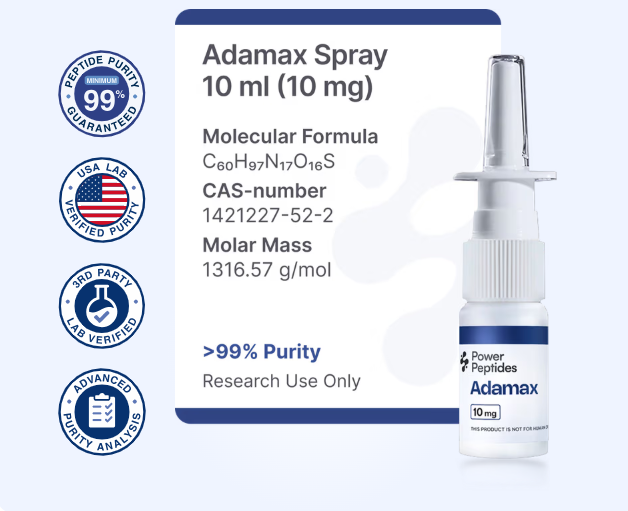
| Molecular Formula | C₆₀H₉₇N₁₇O₁₆S |
| CAS Number | 1421227-52-2 |
| Molar Mass | 1316.57 g/mol |
| Amino Acid Sequence | Ser-Ala-Leu-Leu-Arg-Ser-Ile-Pro-Ala |
| Synonyms | Davunetide, NAP |
| Solubility | Water-soluble |
| Organoleptic Profile | White powder |
| Composition | Synthetic peptide |
How does Adamax work?
Adamax works by mimicking the effects of the activity-dependent neuroprotective protein (ADNP), a key regulator of brain development and function. ADNP is essential for neurite outgrowth, synapse formation, and neuroprotection. Adamax, a synthetic peptide derived from ADNP, binds to microtubule end-binding proteins and promotes microtubule assembly, stability, and transport. This action enhances neuronal survival, plasticity, and connectivity, leading to improved cognitive function and memory.
Adamax also stimulates the release of neurotrophic factors such as brain-derived neurotrophic factor (BDNF) and nerve growth factor (NGF), which support the growth, maintenance, and survival of neurons. Additionally, Adamax exhibits potent antioxidant and anti-inflammatory properties, protecting neurons from oxidative stress and inflammation-induced damage. By reducing the accumulation of beta-amyloid plaques and tau phosphorylation, Adamax may help prevent or slow the progression of neurodegenerative diseases like Alzheimer’s.
Benefits
- Enhances cognitive function and memory: Adamax improves learning, memory retention, and recall by promoting synaptic plasticity and neurogenesis in the hippocampus and cortex.
- Neuroprotective properties: Adamax protects neurons from oxidative stress, inflammation, and toxicity, reducing the risk of age-related cognitive decline and neurodegenerative diseases.
- Promotes neuronal survival and regeneration: By stimulating the release of neurotrophic factors, Adamax supports the survival, growth, and regeneration of neurons, maintaining brain health and function.
- Reduces beta-amyloid and tau pathology: Adamax may help prevent or slow the progression of Alzheimer’s disease by reducing the accumulation of beta-amyloid plaques and tau phosphorylation, two hallmarks of the disease.
- Improves mood and reduces anxiety: Adamax has been shown to have anxiolytic and antidepressant effects, potentially by modulating the levels of neurotransmitters such as serotonin and dopamine.
- Enhances sleep quality: Adamax may improve sleep quality and duration by regulating the sleep-wake cycle and promoting the expression of sleep-related genes.
- Potential treatment for neurodevelopmental disorders: Adamax may be beneficial in treating neurodevelopmental disorders such as autism and fragile X syndrome, which are characterized by cognitive deficits and impaired social interaction.
Side Effects
Adamax is generally well-tolerated, with few reported side effects in preclinical studies. However, as with any experimental compound, more research is needed to fully understand its safety profile and potential long-term effects. Some possible side effects may include:
- Headache
- Nausea
- Dizziness
- Fatigue
- Injection site reactions (if administered via injection)
It is essential to consult with a qualified healthcare professional before using Adamax or any other experimental peptide.
Summary
Adamax is a promising synthetic peptide derived from the activity-dependent neuroprotective protein (ADNP) that offers a novel approach to enhancing cognitive function, memory, and brain health. By mimicking the effects of ADNP, Adamax promotes neuronal survival, plasticity, and connectivity, while protecting against age-related cognitive decline and neurodegenerative diseases. With its neuroprotective, neurotrophic, and anti-inflammatory properties, Adamax may have potential applications in treating various cognitive and neurodegenerative disorders. However, further research is needed to fully elucidate its mechanisms of action, safety profile, and therapeutic potential.


Reviews
There are no reviews yet.